Care the way it should be
Person-centred. Whānau-connected. Grounded in Enabling Good Lives. This is the philosophy that shapes every part of iCareNZ.
Not just what we build, but how we think about care
Every piece of software has a philosophy behind it. Sometimes it's obvious — the features, the workflows, the way data moves through the system. Sometimes it's invisible — the assumptions about who the user is, what they need, what they value.
At iCareNZ, our philosophy starts with a simple question: what would care look like if we designed it around the person, instead of designing it around the system?
That question led us to Enabling Good Lives. Not as a checkbox compliance item, but as a genuine framework for how care should work. The idea that every person — regardless of age, ability, or circumstance — has the right to choose how they live, who supports them, and what matters most to them.

The principles that guide us
Enabling Good Lives isn't a policy document you file away. It's a way of thinking that changes how care feels for everyone involved.
Self-determination
People know what's best for their own lives. Our role is to give them the tools to make it happen — not to decide for them. Care plans, goals, and daily choices all start with what the person wants, not what's convenient for the system.
Mana / Dignity and status
Every person has inherent worth. The way we document care, share updates, and communicate with whānau should uplift that worth — not reduce someone to a file number or a diagnosis code.
Choice and control
From what time someone gets up in the morning to who provides their support — these decisions belong to the person, not the roster. Our scheduling and care planning tools are built to flex around individual choice, not force people into slots.
Whānau and community
Care doesn't happen in a vacuum. People are connected to family, friends, and communities. Good care strengthens those connections. Our family portal and communication tools exist because we believe whānau should be informed, involved, and included.
Relationships are fundamental
The relationship between a kaimahi and the person they support is the most important thing we protect. Everything else — the forms, the compliance, the reporting — should support that relationship, not get in its way.
Strengths-based approach
Instead of starting with what someone can't do, we start with what they can. Care plans should be built around abilities, goals, and aspirations — not just deficits and diagnoses. This changes everything about how care feels.
What this looks like every day
Philosophy is only as good as its application. Here's how these principles show up in the real world of care.
Care plans that belong to the person
A care plan shouldn't be a document that sits in a file and gets pulled out at audit time. It should be a living thing — something the person themselves can see, contribute to, and feel reflects who they are. Our care planning tools are built so that goals are written in plain language, preferences are front and centre, and the person's voice is the loudest one in the room.
Scheduling that bends to the person, not the other way around
We've all seen what happens when scheduling is driven by efficiency instead of preference. People get woken up at times that don't suit them. Support workers change mid-week. Routines get disrupted. Our scheduling tools start with the person's preferences — when they like to wake up, who they prefer to support them, what their day looks like — and builds the roster around that.
Whānau who feel like they're part of the team
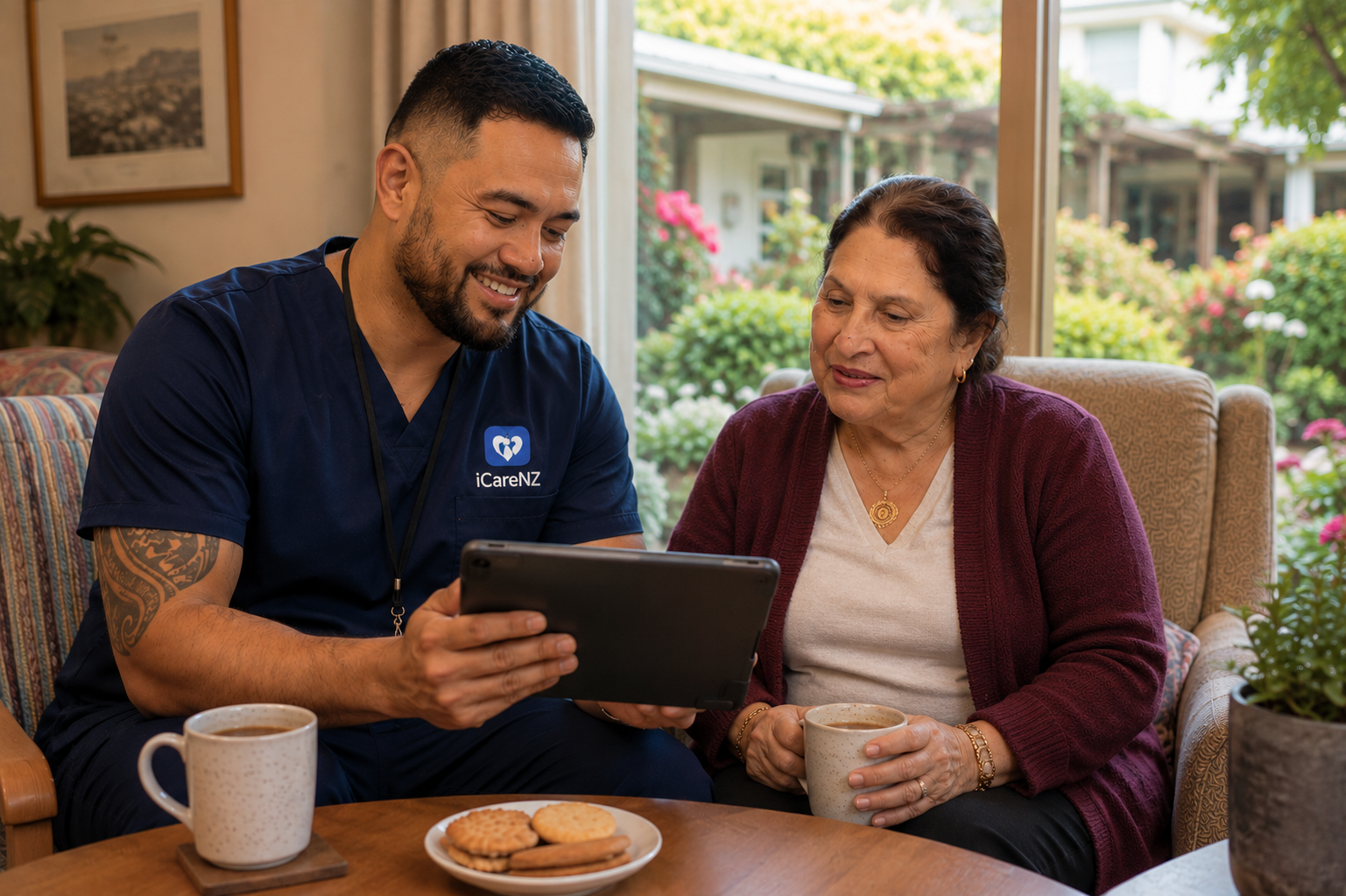
One of the most common things we hear from families is that they feel like they're on the outside looking in. They want to know how Mum's day was. They want to see the photo from the activity this afternoon. They want to feel confident that the people caring for their loved one see them as a whole person, not just a set of tasks. That's why our family portal isn't a bolt-on feature — it's a core part of how iCareNZ works.
Kaimahi who feel supported, not surveilled
The people doing the work deserve respect. Good documentation is about continuity of care — making sure the next shift knows what matters, not about catching mistakes. Our mobile app is designed to make a kaimahi's job easier, not to add another layer of oversight. When documentation takes two taps instead of ten minutes, kaimahi can spend that time where it matters — with the people they support.
Why this matters for Aotearoa
New Zealand's care sector is under pressure. We know that. The population is ageing. The workforce is stretched. Funding is tight. It would be easy to respond by doubling down on efficiency — doing more with less, squeezing every last minute out of every shift.
But we don't think efficiency and humanity are in conflict. We think the opposite is true. When you build systems that respect the person receiving care and the person giving it, everything gets better. Outcomes improve. Staff stay longer. Whānau trust deeper. Audit results reflect the quality that's already there.
That's not wishful thinking. It's what we see happening in the 40-plus facilities already using iCareNZ. Providers who embrace person-centred principles don't just feel better about their work — they perform better by every measure that matters.
Enabling Good Lives was developed here in New Zealand because we understood something important: that our care system should reflect our values as a country. That's still true today. In aged care, disability support, community health, and everything in between — the philosophy of putting people first is what makes care truly good.
This philosophy only works if it's shared
We don't claim to have all the answers. Every provider, every community, every whānau has their own way of doing things. What we offer is a platform that's built on principles we believe in — and we're always learning from the people who use it.
If this philosophy resonates with how you care, we'd love to hear your story. Not so we can sell you something — but because the best ideas come from the people doing the work every day.